> For the complete documentation index, see [llms.txt](https://docs.wicle.io/llms.txt). Markdown versions of documentation pages are available by appending `.md` to page URLs; this page is available as [Markdown](https://docs.wicle.io/visualizing-retention/key-behavior/display-location.md).
# キー行動を利用できる場所
キー行動の一覧での継続状況の比較、検索条件やファンの条件への利用、ユーザー詳細でのフェーズ変化の確認方法を説明します。
キー行動ごとの継続状況を一覧で比較し、気になるフェーズのユーザーを検索して、個別の行動やフェーズの変化を確認できます。
## キー行動一覧
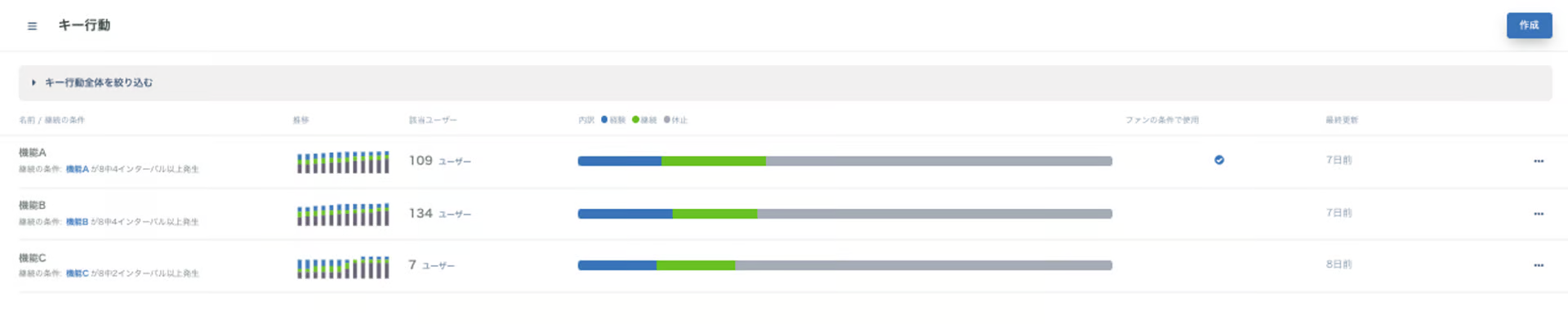
左メニューの `エンゲージメント` から `キー行動` を開きます。
ユーザー単位の一覧では、画面上部で基準日を選択できます。対象を限定して比較する場合は、`絞り込み` を開き、企業名や行動などの条件を設定して `絞り込む` を選択します。この操作は表示対象を絞るもので、キー行動の判定条件は変更しません。
| 項目 | 説明 |
| ---------- | ----------------------------------------------------------------- |
| 名前 / 継続の条件 | キー行動の名前と、継続と判定する頻度です。名前を選択すると条件を編集できます。 |
| 推移 | 日ごとの4つのフェーズの人数の推移です。ユーザー単位の一覧では、基準日までの28日間を表示します。 |
| 該当ユーザー | 表示中の最終集計日に、4つのフェーズに所属するユーザー数の合計です。 |
| 継続ユーザー | 継続に所属するユーザー数と、該当ユーザー全体に占める割合です。 |
| 内訳 | 4つのフェーズの人数と割合です。色の付いた部分にカーソルを合わせると値を確認でき、選択するとそのフェーズのユーザーを検索できます。 |
| 最終更新 | 更新日時と更新者です。 |
| `…` | 条件、名前と説明の編集、削除ができます。ライフサイクルで使用中のキー行動は削除できません。 |
グループ分析モードでは、人数の代わりにグループ数を表示します。グループの集計方法は[グループ分析の詳細仕様](/group-analytics/group_analytics/advanced-spec.md)を参照してください。
## 検索
[ユーザー検索](/analytics/user/search-user.md)などの条件にキー行動を指定できます。特定のフェーズに所属するユーザーや、フェーズが変わってからの日数などで対象を絞り込めます。利用できる項目は[キー行動のディメンション](/visualizing-retention/key-behavior/dimension.md)を参照してください。
## ユーザー
検索結果のユーザーごとに、キー行動のフェーズを確認できます。個々のユーザーがどのように変化してきたかを調べる場合は、ユーザー詳細を開きます。
## ライフサイクルの「ファン」の条件
キー行動は、ライフサイクルの[ファンの条件](/visualizing-retention/lifecycle/edit-lifecycle.md#fan)として利用できます。来訪頻度に加えて、特定の行動を継続しているユーザーをファンと判定したい場合に設定します。
## ユーザーのタイムライン
[ユーザー詳細](/analytics/n1-user/overview.md)の左側にある `エンゲージメント推移` の `キー行動` で、フェーズの変化を確認できます。変化した箇所にカーソルを合わせると、日付と移動先のフェーズが表示されます。すべてのキー行動を確認する場合は `すべて表示` を選択します。
---
# Agent Instructions
This documentation is published with GitBook. GitBook is the documentation platform designed so that both humans and AI agents can read, navigate, and reason over technical content effectively. Learn more at gitbook.com.
## Querying This Documentation
If you need additional information that is not directly available in this page, you can query the documentation by asking a question.
Perform an HTTP GET request on the following URL with the `ask` and `goal` query parameters:
```
GET https://docs.wicle.io/visualizing-retention/key-behavior/display-location.md?ask=&goal=
```
`ask` is the immediate question: it should be specific, self-contained, and written in natural language.
`goal` is what the user is ultimately trying to achieve, the reason they need the answer. Sharing it helps GitBook give you a better, more relevant answer. A goal is most helpful when it describes the outcome the user wants rather than restating the question. For example, with `ask=how do I create an API token`, a goal like `automate deployments from our CI pipeline` lets GitBook tailor the answer to that use case.
The response will contain a direct answer to the question and relevant excerpts and sources from the documentation.
Use this mechanism when the answer is not explicitly present in the current page, you need clarification or additional context, or you want to retrieve related documentation sections.